![AI Tinkerers Zurich April 9th [AI Tinkerers - Zürich]](https://sloppy-joe-app.imgix.net/ai_tinkerers/logos/ai_tinkerers_-_zrich_laptop-sticker_190_c1738ef26b59db4c861ebef29dd15df9.png?w=300&fit=max&auto=format%2Ccompress&q=75)







AI Tinkerers Zurich April 9th


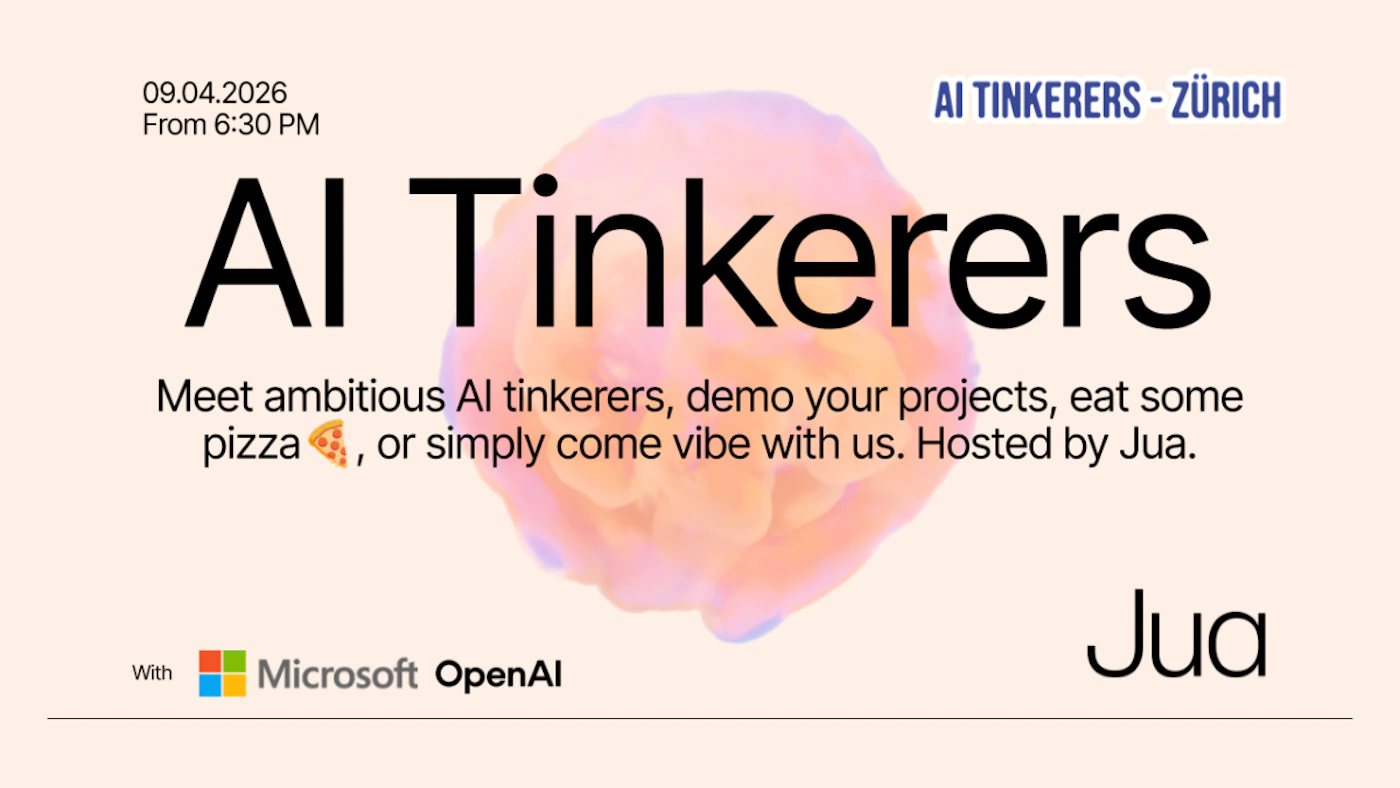
Join us on April 9, 2026, for an evening of hands-on AI building in Zurich. This is a meetup for practitioners: engineers, researchers, and technical founders actively shipping code with foundation models and generative AI.
Our focus remains on the “Homebrew Computer Club” spirit: raw demos, technical implementation details, and shared discoveries. We prioritize working systems over slide decks and technical depth over marketing pitches.
🎤 Call for Demos
We are looking for 5-minute demos of messy experiments, creative hacks, and technical discoveries. Your demo should answer: “How did you build this?” rather than “Why should someone use this?” We value seeing the internals: code, architecture, and the challenges you faced during development.
🏢 Host and Sponsor
Jua
Jua.ai builds AI weather forecasts that outperform traditional physics models and run thousands of times faster. Based in Zurich, the team trains foundation models on petabytes of satellite, radar, and station data to predict wind, solar irradiance, and power output with actionable accuracy. Energy traders and renewable operators use Jua to make better trading decisions and cut rebalancing costs. Athena, Jua’s newest agentic layer, runs in minutes what would take a team of analysts days: think full power grid analysis across an entire country, going back years, in the time it takes to get a coffee. Jua also offer API access, giving developers and researchers direct access to that forecasting infrastructure.

Microsoft for Startups
For startups ready to build fast, scale smart, and sell more.
Access cutting-edge AI models and developer tools to build faster on Azure, backed by Microsoft’s global customer network, enterprise-grade security, and privacy you can trust.
Visit our website: Microsoft for Startups

OpenAI
OpenAI builds AI systems that help developers and teams turn ideas into real, working products faster than ever. At this event, OpenAI will showcase how tools like Codex go beyond code generation to seamlessly connect with APIs, data, and workflows, enabling anyone to build powerful applications in an intuitive, hands-on way.

🕕 Event Schedule
- 6:30pm: Doors open, pizza, and drinks
- 7:00pm: Technical Demos and Q&A
- 8:30pm: Networking and Science Fair
- 9:30pm: Event concludes
🛠️ What to Expect
With the recent release of models like GPT-5.4, GPT-5.3 Codex and Gemini 3.1 Deep Think, the bar for autonomous agents and reasoning systems has shifted. We want to see how you are integrating these advances, whether you are leveraging 1M-token context windows in Claude 4.6 or deploying low-latency speech-to-speech interfaces with openFlashLabs Chroma.
Attendance is limited to 60 builders and is strictly limited to ensure high-signal conversations. Entry is granted based on the technical projects and challenges you share during registration.
📊 Zurich Community Stats
- Community Growth: This community of 730 technical professionals features a robust concentration in AI/ML (37%), Python (15%), and Data Science (13%). The membership is distinguished by high-caliber affiliations with ETH Zürich and Google, alongside a significant 6% entrepreneurial founder base. Notable achievements include a strong focus on agentic workflows and interdisciplinary applications across robotics, fintech, and healthcare sectors.
- Companies Represented: Featuring industry leaders like Google, NVIDIA, Microsoft, and Amazon, alongside AI innovators such as IBM Research, Lakera, Langfuse, and Jua, and emerging startups like Fore AI, Invariant Labs, and Nunu.ai, and more.
- Demo Activity: 44 demos have been submitted and 27 have been presented. The most exciting themes have spanned interactive multimodal/embedding demos (“Hotdogs”), practical GenAI-ready document tooling (“Docling”), agentic automation and infrastructure (“MoonAI”, “Clawloop”), and robotics/RL breakthroughs (“CyberRunner”). Technical focus has also covered evaluation and safety (“Trustworthy and Secure Agents”), plus data-context and interface generation (“Widgens”).
- Member Feedback:
A great demo for this audience is one where attendees can learn the implementation details directly: show the working system (not just slides), surface architecture/code structure, and walk through the specific challenges you hit while building (integration pain, latency/cost constraints, debugging workflow, reproducibility, and how you verified the system). The form explicitly asks for “5-minute, hands-on technical demos” that prioritize the “how,” and the top-rated demos align with that by featuring concrete end-to-end pipelines, specific technical mechanisms, and tangible artifacts like open-source stacks, protocol-level tooling, or executable flows that make it easy for others to replicate. To avoid the negative outcomes, speakers should avoid marketing-heavy framing, vague “inspiration” pitches, and demonstrations that don’t make the engineering work visibly present. Even if a talk is polished or conceptually interesting, feedback indicates that perceived lack of “actual hacking” and insufficient visibility into the build process will hurt—so keep the demo grounded in what you built, how you built it, and what you observed when it worked (or failed) during development.
In Zürich, the demo CyberRunner: How We Open-Sourced the AI That Beat Humans by Aswin Ramachandran was rated highly (4.4/5 average). It was compelling because the “technical ah-ha” centered on sample-efficient Model-Based RL in the real world, with concrete system framing (vision loop, motor control, concurrent learning) and a clear mechanism for why the robot can learn quickly while maintaining sub-millimeter precision. Similarly, Widgens by Max Martinez Ruts scored very well (4.4/5) and received “Incredible!” feedback, suggesting the audience appreciated a crisp, engaging technical direction; even though the content described is mostly declarative UI/CSS, the demo evidently delivered on a practical, understandable showcase that landed well on stage. The most explicitly “technical engineering demo” signal comes from Build MCP apps the easy way by Enrico, rated 4.1/5: the audience liked the idea of quickly creating MCP apps via a CLI/Vibe workflow, including structured tooling concepts like UI widgets, schemas (Zod/Pydantic), and debugging/inspection—though at least one attendee still felt it leaned too marketing rather than hands-on hacking, underscoring the need to make the build steps and code-level decisions highly visible.
🥽 Speakers
The Zero-Partners VC - AI Native VC running on AI Agen…

Yariv Adan
Founding Partner @ ellipsis-venture
A playground to run AIFS experiments using serverless …

Martí Bosch
Scientific collaborator @ University of Bern
Replacing Analysts in commodity trading

Dani
Ai agentic engineer @ Private
Your AI is Two Versions Behind

Stuart Mackay
Senior Security Engineer @ GetYourGuide
Clawloop - the unified learning api

Robert Müller
Founder @ Aganthos
CyberRunner: How We Open-Sourced the AI That Beat Huma…

Aswin Ramachandran
Senior scientist @ ETHZ
From scratch, single file implementation of a scaled-d…

Adrian Scheerer
AI Tinkerer with math background @ open to work
Build MCP apps the easy way

Enrico
CTO @ Manufact (YC S25)